NATO’s eastward expansion is the chief culprit in detonating the Ukrainian crisis.
Guangming Daily reporter Han Xianyang
Russian President Vladimir Putin delivered a televised speech in the early morning of February 24, announcing the launch of special military operations in Donbass, but said that he had no plans to occupy Ukraine. Ukrainian President Zelensky announced later that day that Ukraine would sever diplomatic relations with Russia. At this point, Russia and Ukraine met with each other.
Different from many war scenes after World War II, this war was launched in two countries with Slavic nationality as the main body. It should be said that the Ukrainian issue has its complicated historical latitude and longitude, and the evolution of the situation is the result of the joint action of various factors. Some sober strategists believe that the eastward expansion of NATO by the United States and the West, which continues the Cold War mentality, is the chief culprit in detonating the Ukrainian crisis.
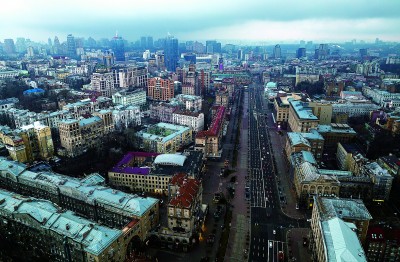
Street view of Kiev, Ukraine, taken on February 24th. Xinhua news agency
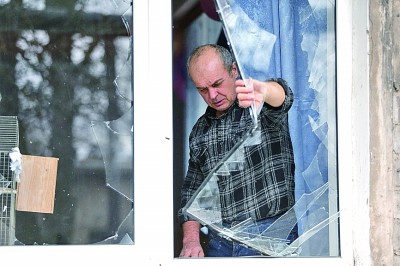
On February 24, local residents in Donetsk looked at the damaged houses. Xinhua news agency
1. Russian-Ukrainian friendship has been the mainstream for thousands of years.
Slavs are a nation in Eurasia, divided into Eastern Slavs, Western Slavs and Yugoslavia. Today, the main ethnic groups in Russia, Belarus and Ukraine belong to Eastern Slavs.
Around the 10th century, East Slavic tribes combined to form the Gulos tribe. In order to change the fragmented situation of internal strife, the Eastern Slavs recruited Ryurik, the leader of Varyag people from Northern Europe, and entered Novgorod, which is located between Moscow and St. Petersburg today. In 862, the Eastern Slavs established the first Russian kingdom in Novgorod-the Lyurik Dynasty. Since then, Ryurik, the Grand Duke of Novgorod, has continued to go inland and controlled some cities along the Dnieper River, including Kiev. They established a Slavic country and began to slavize themselves. After Ryurik’s death in 879, his successor Oleg led the Varyag people to occupy Kiev in 882, and successively conquered some surrounding areas, and established the Russian Principality with Kiev as its capital, which was called "Kiev Ross" or Gulos in history.
Tracing back to the history of Russia and Ukraine is undoubtedly inextricably linked. In this regard, Zhang Jianhua, a famous historian in China and the author of Russian History, regarded Kiev Ross as an inheritance relationship with the Russian Empire, the Soviet Union and the Russian Federation and included it in the "General History of Russia".
During the 12th-14th century, the Gulos tribe, a feudal separatist regime, gradually split into three branches: Russians, Ukrainians and Belarusians. From the 14th century, Ukrainians began to break away from Gulos and form a single nation with unique language, culture and living customs.
In 1648, the Cossacks in Ukraine could not bear Polish-Lithuanian rule, and a great uprising broke out, which was suppressed by the Polish army. In 1654, Khmelnitski, the Ukrainian Cossack leader who assessed the situation, requested Russian protection and signed the Treaty of Peleyaslav with the Russian Tsar, asking the Tsar to rule eastern Ukraine. Since then, Dongwu, located on the left bank of Dnieper River, has formally merged with the Russian Empire, opening the alliance period between Ukraine and Russia. Throughout the empire, Russians generally call themselves "big Russia", accounting for 44%, while Ukraine is called "little Russia", accounting for 18%.
To celebrate the "300th anniversary of the alliance between Ukraine and Russian brothers", Khrushchev, then leader of the Soviet Union, led the Presidium of the Supreme Soviet of the Soviet Union to pass a resolution in 1954, giving the Crimean Peninsula, which was included in the territory of the Russian Empire as early as 1783, from the hands of the Russian Soviet Socialist Federal Republic as a "symbol of lasting friendship" to the Republic of Ukraine. At that time, Russia and Ukraine were both Soviet republics. In the final analysis, the territory change of Crimea was carried out in one country, and it did not cause a big wave.
In the late 18th century, the Polish-Lithuanian kingdom, which ruled western Ukraine, became a vassal state of the Russian Empire. By the end of the 18th century, the Russian Empire, together with Austria and Prussia, had carved up all the territory of Poland-Lithuania and incorporated the whole Ukraine into Russian territory. During this period, the eastern and western parts of Ukraine were clearly divided. Among them, there is little difference between eastern Ukraine and Russians who believe in the Orthodox Church and have been merged with Russia for more than 100 years. The western Ukraine, which believes in Catholicism and has been a part of the Polish-Lithuanian kingdom for more than 100 years, is dissatisfied with the rule of Russia and has repeatedly broken out with the Eastern Orthodox Christians.
In 1917, the February Revolution and the October Revolution broke out in Russia, which were regarded by Ukrainian national independents as a godsend opportunity for their independence and the People’s Republic of Ukraine was established. Soon after, the Bolsheviks also established the "Ukrainian Soviet Republic" in the east. The People’s Republic of Ukraine, which could not resist the attack of the Soviet Red Army, took refuge in Germany, attacked Soviet Russia and occupied Kiev. Since then, the Soviet Red Army has defeated Petlyura Army, Vrangel Army and Machno Army, and Ukraine has become a political entity again. According to Lenin’s suggestion, the Ukrainian Soviet Republic joined the Union of Soviet Socialist Republics as a country in 1922 and became one of the founding countries of the Soviet Union.
During the Great Patriotic War of the Soviet Union, Kiev, Odessa, Sevastopol and other "hero cities" and groups bravely fighting Nazi Germany emerged in Ukraine, and many of them chose to cooperate with Germany to become "Soviet traitors", and even tens of thousands of Ukrainians joined the SS. After the war, although the contradiction between Russia and Ukraine has eased, the psychological rift has always been lingering.
2. The United States and NATO use Ukraine to "contain Russia" and "weaken Russia"
On December 8, 1991, in the official residence of the Viskuli government in Belovezh forest in the Republic of Belarus, leaders from the three Soviet republics of the Russian Federation, Ukraine and Belarus signed the Agreement on the Establishment of the Commonwealth of Independent States, declaring that "the Soviet Union has ceased to exist as a subject of international law and a geopolitical entity".
Russian strategists and historians generally believe that the disintegration of the Soviet Union 30 years ago was due to a series of domestic policy mistakes made by the party and state leaders, and the western countries led by the United States could not escape. In this process, the destructive activities carried out by Washington found partners within the Soviet Union and were carried out by so-called "dissidents". More accurately, the Soviet Union was not "disintegrated" by itself, but was "destroyed", and foreign forces played a key role in this process.
After the disintegration of the Soviet Union, the United States and the West celebrated each other. Brzezinski, former national security assistant to the President of the United States, once proudly said in "The Big Chess": "An expanded and democratic Europe must be an endless historical process and should not be limited by geography that is arbitrarily smeared in politics." He further said that if Russia wants to avoid being dangerously isolated in geopolitics, it must deal with an enlarged transatlantic EU and NATO.
Brzezinski also reminded the American government at that time that, from the geopolitical point of view, losing Ukraine has a decisive influence on Russia, because it greatly limits its geostrategic choice … Losing Ukraine and its more than 52 million Slavs, any attempt by Moscow to rebuild the Eurasian Empire may plunge Russia into a lasting conflict with non-Slavs who have awakened in nationality and religion … Because the birth rate in Russia is declining and the population in Central Asia is increasing sharply, any new Eurasian Empire without Ukraine is only based on Russian power.
In the past 30 years, the United States and NATO have constantly used the Ukrainian issue to stimulate Russia. Despite the constant discord, the forbearing Russia and Ukraine, which still have pro-Russian forces, can still maintain normal state relations in the first 20 years. From 2013 to 2014, the "color revolution" that broke out in Ukraine fundamentally changed Russia-Ukraine relations.
On November 21, 2013, the then Ukrainian President Yanukovych announced that he would suspend the signing of the contact country agreement aimed at strengthening trade relations with the EU, and instead sought closer cooperation with Russia. The United States and Europe supported the opposition to set off a wave of protests and overthrew Yanukovych’s regime. In this process, the US government made no secret of its support for the "color revolution". At that time, Assistant Secretary of State Newland distributed cookies to the protesters occupying the central square of Kiev to support the opposition.
During the two presidencies of poroshenko and Zelensky, the United States and NATO increased their infiltration into Ukraine. Through all kinds of conditional assistance, in the name of fighting corruption, the United States not only actively supports "anti-Russian" and "pro-American" forces, controls Ukraine’s strategic economic sector, but also exerts a key influence on Ukraine’s judicial circles.
What makes Russia feel at ease most is that the United States has not stopped the process of promoting Ukraine’s substantive "entry into the treaty" for a day. The "real but nameless" base established by NATO countries such as the United States and Britain on Ukrainian territory is the direct cause of Russia’s showdown with Ukraine, the United States and NATO.
According to media reports, NATO countries have so far established nine secret military bases in Yavorov, Lviv, Odessa, Mihailovka, Aleshki, Kherson, Xiaoliubasha, Rovno, goncharov Skoye, Chernigov, Zimenyi Island on the Black Sea, Mari upor, Donetsk and Shostka, Sumei, with thousands of military personnel. In these secret bases, the United States, Britain, Latvia and other countries sent instructors to train Ukrainian troops according to NATO standards; The United States has built the Ochakov Ship Combat Control Center for Ukraine and a naval base for NATO troops in the future; The US Department of Defense sent "transnational threat experts" to train Ukrainian security agents to engage in sabotage activities against Russia; At the 73rd Maritime Special Operations Center in Ochakov, MI 6 organized a three-week training course for the Military Diplomacy College of the General Intelligence Department of the Ukrainian Ministry of National Defense.
In addition to building a military base against Russia and strengthening military cooperation in Ukraine, NATO has also provided Ukraine with weapons, ammunition, warships, heavy equipment, radars and other military technical equipment needed to wage war in the past few years.
3. The United States and the West treat Russia’s security concerns negatively
In fact, the International Affairs Committee of the famous Russian think tank predicted the "five endings" of the Ukrainian crisis as early as last October. First, Russia gave up its national interests and "yielded" to NATO as it did in the 1990s. Second, the relationship between Russia and NATO will be frozen at the current level, which is reflected in the situation in eastern Ukraine. The United States and NATO will restrain Kiev’s behavior and avoid a large-scale exchange of fire on the Donbass contact line. Third, the relationship between Russia and the United States and the West has further deteriorated. The Ukrainian government has diverted domestic contradictions intensified by rising energy prices through a local conflict, and Russia has been forced to copy the "Crimea model" to promote Donbass’ independence and even "entry into Russia" through a referendum. Fourth, Ukraine’s domestic contradictions have intensified and the political situation has been turbulent. Russia supports the Ukrainian armed forces to completely occupy Donbass and encourages the eastern and southeastern States of Ukraine to leave. Ukraine is facing dismemberment. Fifth, global reconstruction, that is, Russia and NATO launched an all-round confrontation. One result is that Donbass and even the whole of Ukraine will be merged into Russia.
Obviously, the Ukrainian crisis is moving towards the most extreme fifth scenario. But in fact, if the United States and NATO took Russia’s security concerns seriously, the Ukrainian crisis would not have developed to such a situation.
In the past two months, Russia, the United States and NATO have pursued two goals in the game over Ukraine, namely, the "big goal" of forcing the West to provide security for Russia and the "small goal" of implementing the new Minsk agreement according to Russia’s requirements.
On December 15th, last year, faced with the grim external situation of "no retreat" and the sudden increase in the risk of misfiring on the Ukrainian issue, Russia submitted two drafts, namely, the Agreement on Ensuring Security Measures between the Russian Federation and NATO Member States and the Treaty between the Russian Federation and the United States of America, to NATO and the United States respectively. From January 10 to 13, Russia held intensive dialogues with the United States and NATO on a series of security issues, such as the situation in Ukraine and NATO’s eastward expansion, and expounded Russia’s security concerns and European security vision at the special meeting of the Permanent Council of the Organization for Security and Cooperation in Europe (OSCE). However, Russia’s core concerns such as clearly drawing a "red line" and putting forward the principle of "indivisible security" have been ignored by the United States and NATO. The United States and NATO shifted the focus of security dialogue from the political level to the military technology field, and put forward specific issues such as restoring the Intermediate-Range Missile Treaty, restricting military exercises and military deployment, enhancing the transparency of exercises, and resuming diplomatic missions between Russia and NATO.
The New Minsk Agreement is a series of measures to implement the Minsk Agreement signed by Germany, France, Ukraine and Russia in the capital of Belarus in 2015. It has been unanimously recognized by the UN Security Council Resolution 2202 and has become the key to deal with the Udon Donbass issue, which should be fully and effectively implemented by all parties concerned. However, most of the terms in the agreement have not been really implemented. In this process, the United States and Europe, which have influence on the Ukrainian government, did not play a constructive role, but did nothing.
On February 24th, Russia launched a special military operation in Donbass, and the Ukrainian crisis was detonated.
Now, the United States and NATO are afraid to avoid scenes that may be involved. US President Biden immediately stated that he was "monitoring the situation in Ukraine at the White House", and his spokesman reiterated that he would not send troops to Ukraine under any circumstances.
On the 25th, Ukrainian President Zelensky said that the West had completely abandoned Ukraine. He said that leaders of 27 European countries have been asked whether Ukraine can join NATO, but no reply has been received.
A Russian strategist vividly compared the Ukrainian crisis scene to reporters: 30 years ago, two brothers, Russia and Ukraine, separated. At first, although the two families had quarrels from time to time, they were still at peace. At this time, NATO and the United States, a third party with the mission of "containing Russia" and "weakening Russia", joined in, encouraging the younger brother to oppose his brother everywhere every day, and even using his younger brother’s home as a fortress against his brother. When my brother was furious, NATO and the United States, the third party, ran away.
Wu Dahui, vice president of Russian Research Institute in Tsinghua University, elaborated on the current Russian-Ukrainian crisis quite incisively. He believes that NATO’s eastward expansion cannot maintain peace and stability in Europe and is not conducive to long-term stability in Europe. NATO’s promise not to accept Ukraine could have prevented a war, but the United States and Europe did not. This fully reflects the stupidity of the European leadership in not knowing the current situation. The American leadership hopes to use this crisis to achieve the "bad" of "eating" living in Russia, "sandwiching" living in Europe and "watching" living in economic interests. Thus, a war that could have been avoided was ignited in Ukraine.
Ukraine, which should be a bridge between the East and the West, has now become the frontier of great power confrontation. The deterioration of the situation in Ukraine and the fact that the United States and NATO pursue the Cold War mentality to provoke confrontation and only care about interests without morality are enough for those forces who are willing to be pawns and pawns of hegemonic countries to think twice.
Guangming Daily (February 26, 2022, 08 edition)
Source: Guangming Net-Guangming Daily